


 Software & Cloud Ecosystem · Auvix Portfolio
AGM Cloud
AGM Cloud is a production-deployed, multi-tenant workforce and operations platform for field-operations businesses, connecting scheduling, time tracking, job evidence, customer workflows, billing, and analytics in one system.
Overview
A production platform for the work that happens outside an office.
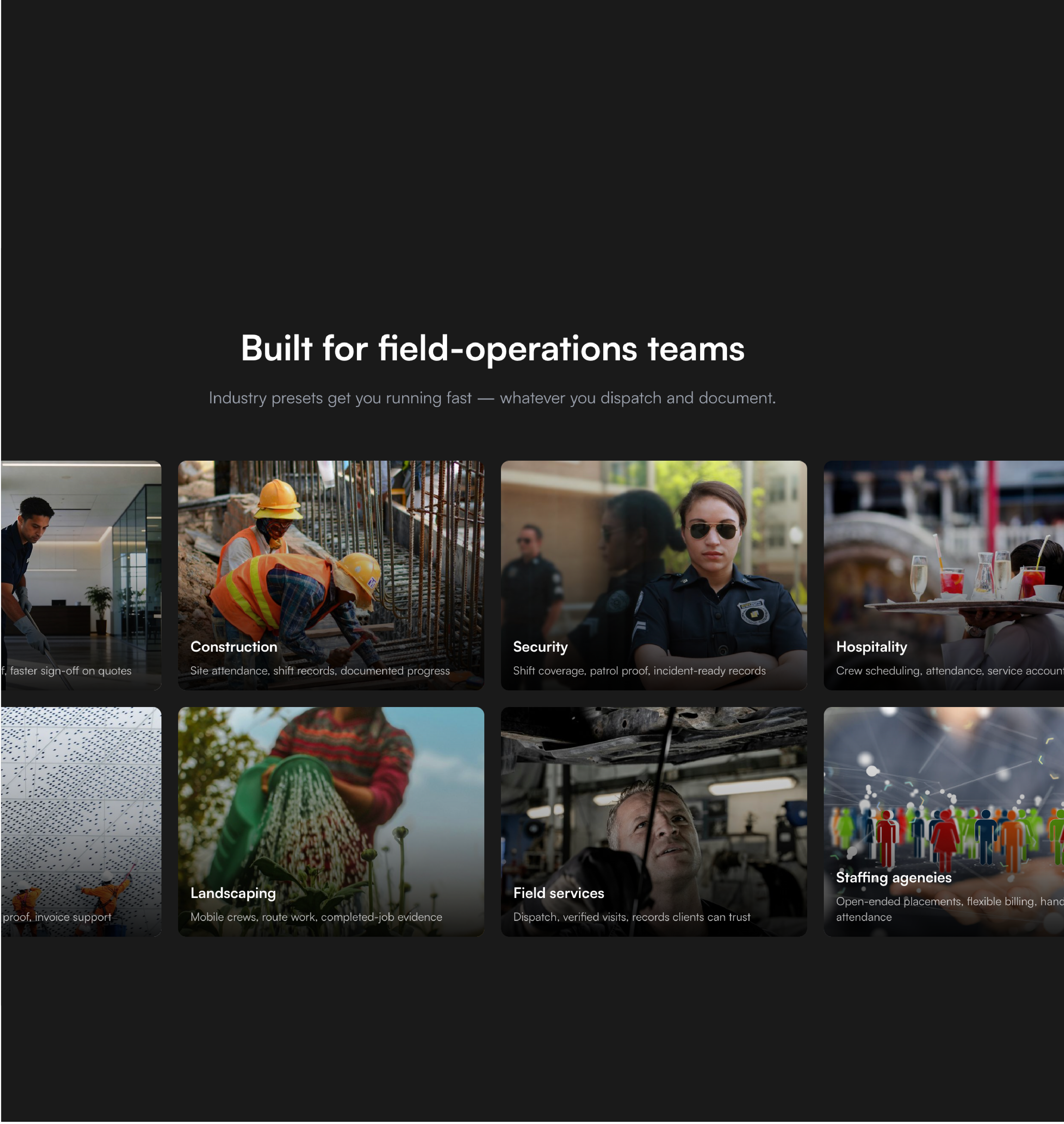
AGM Cloud is a multi-tenant workforce and operations platform built by AUVIX for field-operations businesses, companies whose work happens at job sites rather than at a desk. It brings scheduling, time tracking, photo verification, client management, quoting, contracts, and invoicing into one connected workspace, so a company's office and its field crews operate from the same record rather than separate ones. The platform is built to serve eight industries out of the box: cleaning, construction, security, hospitality, maintenance, landscaping, field services, and staffing, though its industries do not carry equal proof of adoption today. AGM Cloud is a commercial software product in its own right, built for field-operations businesses generally rather than as an internal AUVIX tool, and it sits within the broader AUVIX technology ecosystem alongside the AUVIX portfolio companies it can also support, among them AGM Cleaning Services, its flagship design partner and demonstration tenant.
Challenge
One business, told in a dozen disconnected records.
Field-operations businesses generate the same story in a dozen different places. A schedule says who is supposed to be where. A time sheet says who actually worked. A photo shows whether the job was really finished. A quote and a contract describe what was promised. An invoice describes what is owed. When those records live in separate tools, or exist only in memory, an office loses the ability to confirm that what was promised matches what happened. AGM Cloud's challenge was to build a single operational system where field evidence and office records describe the same underlying work, so a company can trust its own data enough to act on it: to invoice with confidence, to staff correctly, and to answer a customer's question with a fact instead of a guess.
Strategy
Verified operations first, commercial layers on top.
AGM Cloud's strategy separates the platform into two layers, built in a deliberate order. The foundation establishes who a company's users are and what they are allowed to see: tenant isolation so no company can view another's data, role-based experiences for workers, dispatchers, company admins, clients and AGM Cloud's own platform administrators, and a verified record of field activity, geofenced clock-ins, photo proof of work, and time entries tied directly to jobs. On top of that foundation sit the commercial layers a growing company actually needs: a client and lead pipeline, quotes with pricing informed by a company's own invoice history, contracts with e-signature, and analytics built from the same verified time and job data rather than a separate, disconnected reporting system. That ordering is deliberate. None of the higher layers are trustworthy unless the operational record underneath them is accurate first. AGM Cleaning Services served as AGM Cloud's flagship design partner and demonstration tenant, its cleaning-services workflow helping inform and validate the platform's field-operations model.
Design
Five roles, one platform, different jobs to do.
AGM Cloud carries its own visual identity, distinct from AUVIX's corporate mark and from the other AUVIX portfolio brands: a navy and gold system with a reserved gradient treatment for the logo itself, paired with Poppins for headings, Inter for body copy, and Manrope for interface and system text. That identity sits underneath an interface built around role, not a single generic dashboard. A worker's experience is mobile-first and deliberately narrow: clock in, view a schedule, upload a photo, see only their own information. A company admin or dispatcher works from a fuller operator workspace covering employees, jobs, scheduling, clients, and the commercial tools a company's plan includes. A client sees a read-only portal scoped to their own jobs, photos and invoices. AGM Cloud's own platform administrators work from a separate control plane entirely, covering tenant management and platform-wide metrics rather than any single company's operations. Keeping those surfaces distinct, rather than exposing one dashboard to everyone with permissions layered on top, is what lets each role see exactly what its job requires and nothing else.
Technology
Architecture built around a single operational record, not a stack of features.
AGM Cloud's technology choices follow the product's structure rather than the other way around. A Next.js and React web application handles both the public marketing site and the product itself, so a company's entire experience, from first learning about the platform to running its daily operations, lives in one codebase. A separate NestJS backend owns everything that touches money, identity, or another company's data: it is the only part of the system that reads the PostgreSQL database, sends email, charges a card, or calls an AI provider, which keeps those responsibilities out of the browser entirely. Tenant isolation is enforced at that backend's data-access layer, not left to the interface to hide correctly, so one company's jobs, clients, and invoices cannot surface in another's. Authentication and multi-factor verification protect that boundary at the account level, with additional step-up checks required before sensitive actions like billing changes or data exports. Photo storage, transactional email, and billing are each handled by a dedicated external service rather than built in-house, so the platform's own code can focus on the operational logic that makes it AGM Cloud rather than reimplementing infrastructure other services already do well. Scheduled background jobs run independently of any single user's session, catching things like a missed clock-out or an ending trial whether or not anyone happens to be looking at the screen. An AI layer assists with drafting and pricing suggestions but never acts unsupervised: every output is a draft for a person to review. A native mobile app and an installable, offline-capable web app both exist so a worker can clock in and document a job from the field even without a signal, syncing once connectivity returns. Together, this architecture is built to support one continuous operational record rather than a set of disconnected features layered on top of a database.
Execution
A system built in the order that made each layer trustworthy.
AGM Cloud was built by sequencing systems, not by assembling screens. Tenancy and identity came first: company workspaces, roles, and authentication, because nothing else can be trusted without knowing who a user is and which company they belong to. Workforce operations followed: employee records, jobs, scheduling, geofenced time tracking, and photo proof of work, establishing the verified operational record the rest of the platform depends on. Client management came next, followed by the commercial layers built on top of it: a lead and quote pipeline with invoice-history-informed pricing, contracts with e-signature, and billing through Stripe. Analytics and AGM Cloud's own platform-administration tools were built once there was real operational and financial data to report on, rather than ahead of it. The AI-assisted features, a site chat assistant, quote-pricing suggestions, and contract and email drafting, were added as a layer on top of that foundation, directed and governed by AUVIX. What holds the system together is that roles, plan entitlements, and tenant boundaries are enforced on the server, in the code that handles each request, not only shown or hidden in the interface, so what a user is allowed to do matches what the platform actually permits.
Outcome
A production platform, not a prototype.
AGM Cloud is production deployed today. Its marketing site, its application, and its backend API are each live and independently reachable: a working marketing site, a functioning application behind authentication, and a backend API that reports a healthy status when checked directly. The platform has a defined, tiered pricing architecture, and its plan entitlements are enforced on the server rather than only shown or hidden in the interface. Beneath that, AGM Cloud contains substantial implemented functionality across workforce management, customer and commercial workflows, financial operations, and platform administration. What is not claimed here is any measure of business success: no claim is made about paying customers, revenue, adoption, growth, or market traction, because none of that has been separately measured or supplied. The defensible outcome is that AUVIX moved AGM Cloud from product strategy and architecture into a production-deployed SaaS platform with implemented workforce, customer, financial, administrative, and AI-assisted functionality.
Product Gallery
Genuine screens from the production application.
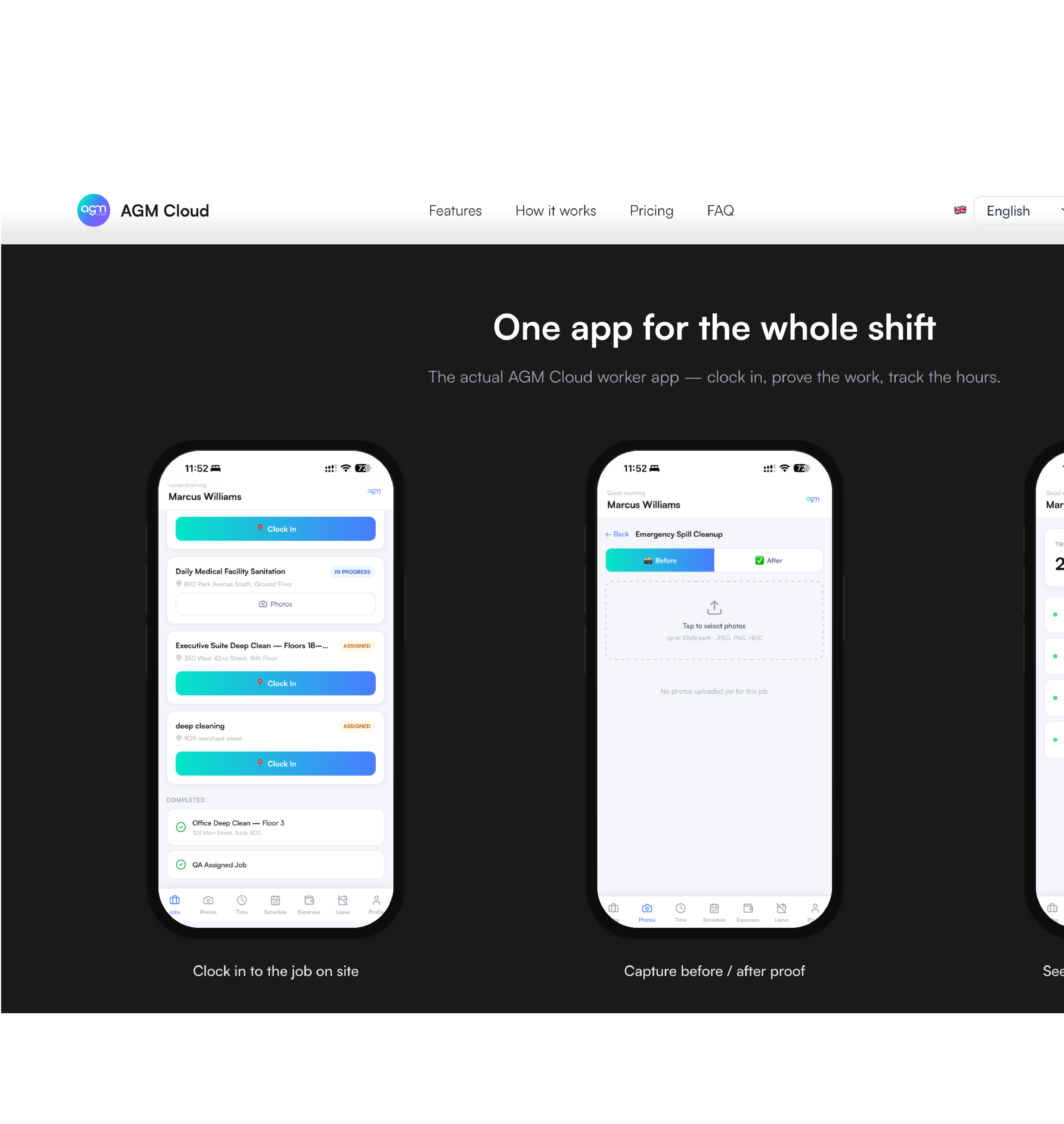
The images in this section are real screenshots captured directly from the running AGM Cloud application, not conceptual mockups: live GPS worker tracking, the branding settings a company uses to personalize its dashboard, the AI-assisted customer-reply drafting tool, the tiered billing plans, and a worker's mobile photo-verification screen for a job. A worker's name visible in the original photo-verification capture has been blurred for privacy. Thirty-seven screenshots were reviewed in total; most of the others show real account-holder or demo-tenant names and email addresses and were not selected for publication here.
Technology Stack
The verified technical system, named precisely.
The frontend is a Next.js and React application written in TypeScript, styled with TailwindCSS and using ShadCN for its component system. The backend is a separate NestJS service, also in TypeScript, using Prisma as its ORM against a PostgreSQL database hosted on Neon, with pooled and direct connections split for application traffic and migrations respectively. Authentication combines JWT sessions, bcrypt password hashing, and time-based two-factor authentication. Photos are stored in AWS S3, transactional email runs through SendGrid, and billing runs through Stripe. Scheduled work, including trial-ending reminders and missed clock-in and clock-out checks, runs on Vercel Cron. AI features are powered by Google Gemini for the site chat assistant, quote-pricing suggestions, and contract and email drafting, with a separate OpenAI integration reserved for AGM Cloud's own platform-administrator tools. A React Native and Expo mobile application serves workers and admins, and the web application installs as a progressive web app backed by an offline mutation queue. Continuous GPS movement tracking and per-worker timezone handling are represented in the product's direction but are not part of what is implemented today.