


 Technology Product · Auvix Portfolio
Boafo
A technology product built and engineered end-to-end by AUVIX, from product strategy through interface design to backend systems and deployment.
Overview
Professional relationship infrastructure, not another social feed.
Boafo is a relationship infrastructure platform built by AUVIX for founders, investors, executives, mentors, and operators. It is designed around trust-based professional relationships and the opportunities that follow from them, rather than the engagement-driven feed model of conventional social platforms. Within the AUVIX portfolio, Boafo is the clearest evidence of AUVIX's ability to build a software product end-to-end: product strategy, brand, interface design, and backend engineering, developed as one connected system rather than separate workstreams.
Challenge
Turning identity into trust, and trust into opportunity.
Professional relationships depend on a chain that's easy to state and hard to build: identity has to become credibility, credibility has to earn trust, trust has to surface the right relationships, and those relationships have to turn into real introductions and opportunities. Most tools address pieces of that chain in isolation. A profile here, a message there, without a system connecting them. The challenge behind Boafo was building that chain as a coherent product: structured identity, an explicit trust layer, and a deliberate way to connect the right people, rather than leaving relationship-building to whichever tool happens to be open.
Strategy
Foundational infrastructure first, advanced features on top of it.
Boafo's product strategy prioritizes structural components over surface features: a professional identity model, an explicit trust layer, and a way to connect people are built first, because everything else, including richer discovery, communication, and community, depends on them being right. Professional identity extends beyond a name and title into company context, work history, and, for investors, a stated investment thesis. Trust is represented directly rather than assumed: vouches from other members, formal connections, and a double-opt-in introduction flow that requires both sides to agree before a relationship is established. On top of that foundation sits a matching system that surfaces relevant people using shared industries, complementary needs and offers, geography, and role pairing: deterministic and explainable by design, so a member can see why a match was suggested rather than receiving an opaque recommendation. That approach fits where the product is today: the infrastructure it depends on is real and working, and the matching logic is built to be trustworthy on its own terms rather than dependent on a more complex system layered on top before the foundation was proven.
Design
An interface built to carry professional weight.
Boafo's interface uses a dark-first design system built around Satoshi, a typeface chosen for a professional, editorial register rather than a casual one. The color system, built from a primary blue, a secondary purple, and a teal accent, is used deliberately rather than decoratively: it distinguishes brand moments, status states, and interactive elements without competing with the actual content of a profile or a trust relationship, which is the part that matters most. The dark-first surface hierarchy of background, elevated surface, card, and border layers, each a step lighter than the last, gives the interface depth without relying on heavy borders or drop shadows, keeping the focus on names, roles, and relationships rather than chrome.
Technology
One product, built across mobile, web, and desktop from a single codebase.
Boafo's client is built in Flutter, which lets one codebase target iOS, Android, web, and desktop rather than maintaining separate implementations per platform. State is managed with Riverpod, navigation with go_router, and the client talks to the backend over both REST, via Dio, and GraphQL. The backend is a NestJS service written in TypeScript, exposing REST and GraphQL through Apollo side by side, backed by PostgreSQL through TypeORM, with Redis handling caching and Bull managing background jobs. Authentication is built for how professionals actually sign in: JWT-based sessions with Passport, OAuth through Google and Apple, magic-link email sign-in, phone verification, and time-based two-factor authentication. AWS S3 handles file storage, Twilio supports phone verification, and transactional email runs through SMTP. An OpenAI integration is configured in the backend as infrastructure prepared for future functionality; it is not connected to any feature in the product today.
Execution
A system, engineered in a deliberate order.
Building Boafo meant sequencing systems rather than assembling screens. Authentication came first, because everything else depends on knowing who a member is. Identity modeling followed: profiles, work experience, education, company records with team members, and investment theses for investors, giving the platform a structured, verifiable professional identity rather than a freeform bio. Trust infrastructure came next: vouches, connections, and a double-opt-in introduction flow that only completes when both members agree, backed by mutual-connection lookups so a member can see how they're actually related to someone before reaching out. Matching was built on top of that foundation, not ahead of it, so the people it surfaces are evaluated against real profile and trust data rather than a placeholder dataset. The next items on the roadmap, messaging, an activity feed, notifications, Mastermind Pods, semantic search, and AI-assisted features, were deliberately sequenced after this foundation, not skipped, because a relationship platform without a working trust and identity layer underneath it has nothing real to connect.
Outcome
A working software foundation, not a market result.
What Boafo represents today is an implemented product foundation, not a market outcome. Authentication, professional profiles, company and investor context, a working trust graph, and a deterministic matching engine are built and functioning in the codebase, not concepts or mockups. Messaging, an activity feed, notifications, Mastermind Pods, semantic search, and AI-assisted features remain on the roadmap and are not part of the product today. No claim is made here about users, adoption, revenue, or market traction; none of that has been measured or supplied. The outcome worth stating plainly is a more limited one: AUVIX took a product from strategy and design through to an implemented technical system, sequencing its hardest problem, trust, before building the features that depend on it.
Product Gallery
Genuine screens from the running application.
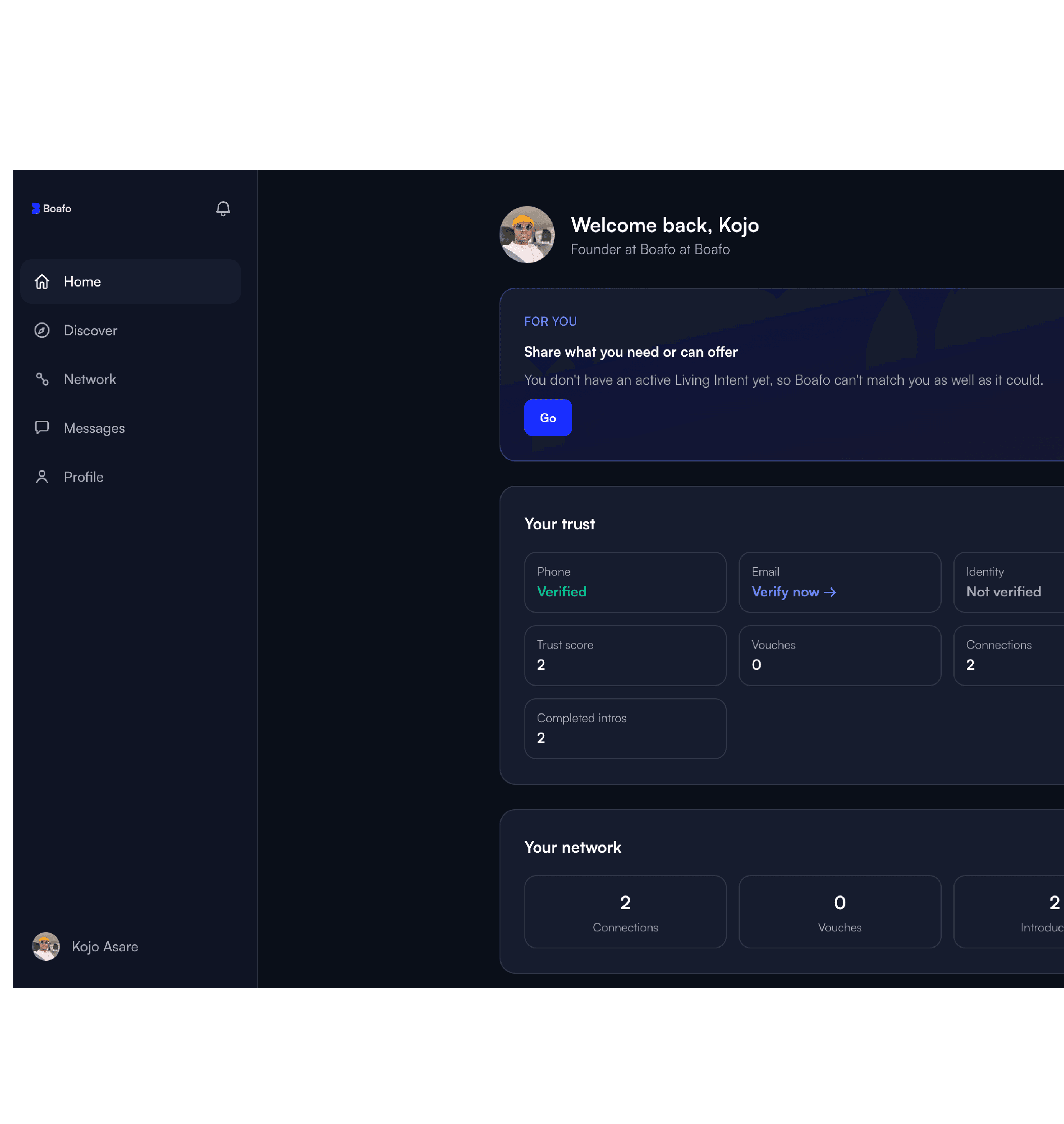
The images in this section are real screenshots captured directly from the running Boafo application and its public marketing site, not conceptual mockups. They show the landing experience and the Discover tab, where members are surfaced as potential connections along with the stated reason for the match. A member's name and profile photo visible in the original Discover capture have been blurred for privacy. Screens for other areas of the product, including profile, company profile, investor profile, and the trust and introduction flow, are not yet included here.


Technology Stack
A modular architecture built beyond the prototype stage.
Boafo's technical choices reflect a product meant to hold real trust relationships and professional data, not a prototype. Flutter gives the client a single codebase across the platforms targeted by the product. NestJS and TypeScript give the backend a typed, modular structure, with REST and GraphQL both available depending on what a given client needs. PostgreSQL, through TypeORM, is the system of record for identity, profiles, and trust relationships; Redis and Bull handle caching and background work without blocking the main request path. Authentication draws on established patterns: JWT, OAuth, time-based two-factor authentication, rather than a custom-built scheme. Some of the product's stated technical direction, including a graph database for more advanced network analysis and AI-assisted features, is prepared for in the codebase's structure but is not yet implemented; this stack reflects what has actually been built, not the full roadmap.