

 Operations Intelligence · Auvix Portfolio
CodeEye
CodeEye is an operations intelligence product prototype designed to bring infrastructure health, incidents, API performance, cloud costs, mail delivery, security events, logs, and AI expenditure into one unified operational view.
Overview
An interface for the signals operations teams usually track apart.
CodeEye is an AUVIX product concept and functional frontend prototype for operations intelligence: a single interface intended to bring system health, incidents, API performance, cloud expenditure, mail infrastructure, security events, logs, analytics, and AI expenditure into one operational view.
AUVIX owns CodeEye and has directed its product concept, brand direction, UX/UI, and frontend development to its current stage. What exists today is the interface: a working, responsive application shell that establishes how an operations intelligence platform built by AUVIX would look, navigate, and organize its information, built ahead of the backend systems that would eventually power it.
Challenge
Operational visibility usually lives in a dozen separate tools.
Operations and engineering teams typically monitor system uptime, incidents, API performance, cloud costs, mail deliverability, security events, logs, and AI usage through separate, disconnected tools, each with its own interface and its own login. That fragmentation makes it harder to see the full operational picture at a glance and slower to act when something needs attention.
CodeEye's premise is that these signals belong together in a single, coherent interface rather than scattered across many. That premise is the starting point for the product concept, not a conclusion drawn from a specific deployed customer's experience.
Strategy
Design and prove the interface before building the systems behind it.
AUVIX's approach to CodeEye starts with the interface rather than the infrastructure. The strategy was to define the information architecture across each operational domain, establish a consistent visual and interaction system, and validate the experience as a working frontend prototype before committing to backend architecture, data integrations, or infrastructure decisions.
Sequencing the work this way lets the product's structure and usability get tested and refined early, while backend investment stays deferred until the interface direction is settled.
Design
A calm, data-dense interface built for scanning, not searching.
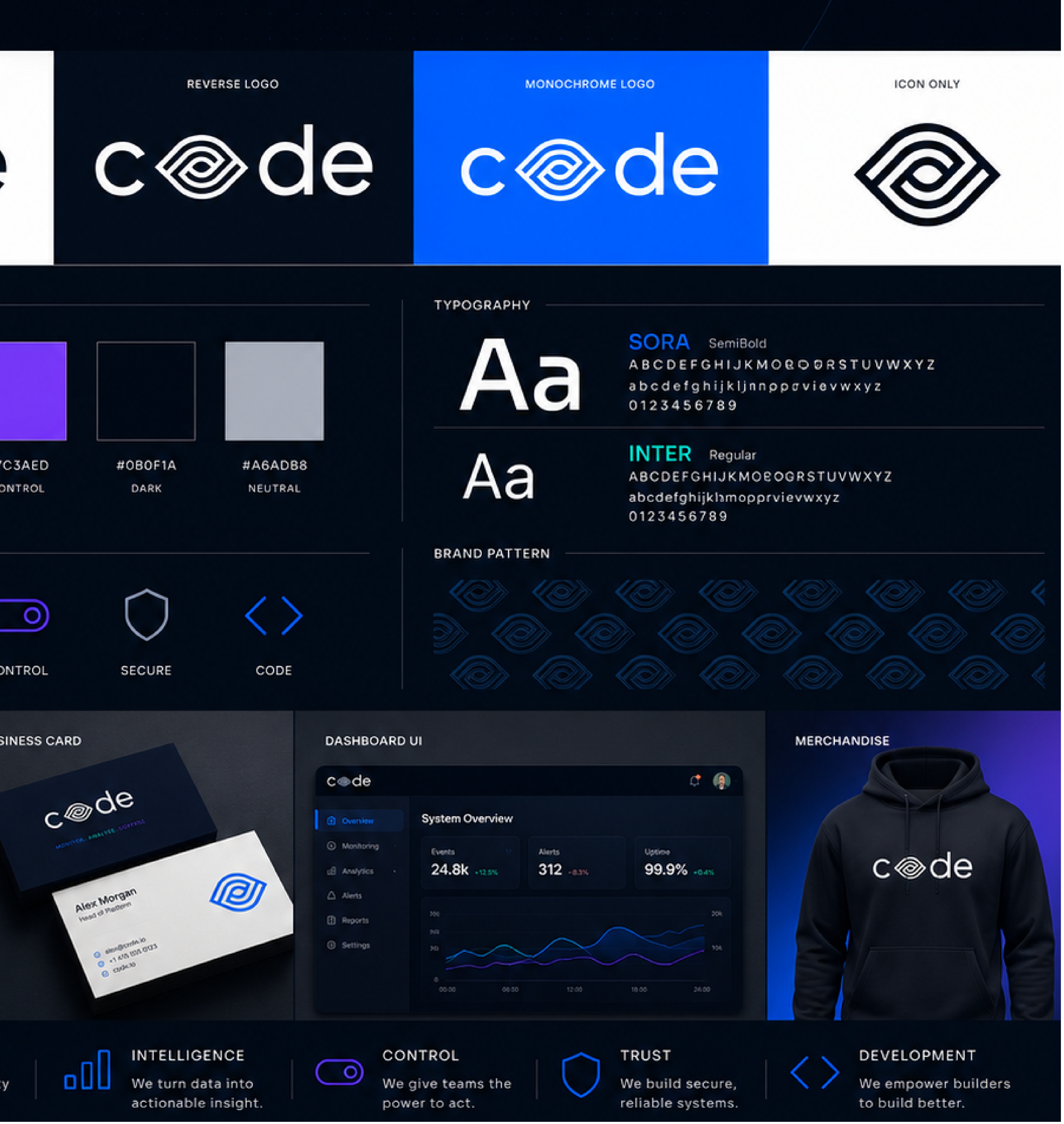
CodeEye's visual system uses a light, uncluttered canvas with a single cyan accent reserved for interactive elements, and a small, consistent set of status colors for ok, warning, and error states. Sora carries headings, Inter carries body text, and JetBrains Mono renders technical values like latency and request paths, a deliberate typographic split between narrative text and operational data.
The interface is organized around compact KPI cards and data tables rather than dense charts, so each operational domain can be scanned quickly. Navigation uses a persistent sidebar on desktop that collapses into a mobile overlay on smaller screens, with layout and spacing decisions built specifically for that responsive behavior rather than added after the fact.
Technology
A frontend architecture built to grow into more operational views.
CodeEye is built on Next.js's App Router, so each operational domain, overview, analytics, incidents, APIs, cloud, mail, security, logs, and AI usage, is its own routed section rather than a single monolithic page. TypeScript defines shared, strongly typed data shapes for every domain (monitors, incidents, endpoints, cloud services, mail metrics, security events, AI usage), so the interface and its underlying data models stay consistent as more sections get built out.
Tailwind CSS and a shadcn and Radix UI component system provide a consistent, themeable, accessible UI kit instead of one-off styling per page, and Recharts is included in the stack to support the time-series charting the product will need once real data exists to chart.
This is a description of the frontend as it exists today. CodeEye does not yet have a backend, a database, or any live data source behind this interface, and this section makes no claim otherwise.
Execution
Nine operational sections, built in one consistent interface language.
AUVIX built CodeEye's responsive application shell, its full visual design system, and its marketing landing page first. On top of that shell, the Overview and Analytics sections render structured tables and data cards from a local, developer-defined dataset built specifically to represent what each domain's real data would eventually look like. Seven further sections, Incidents, APIs, Cloud, Mail, Security, Logs, and AI Gateway, establish the shape and layout of each remaining operational domain using representative static values.
All data shown across every section today is static or locally defined placeholder data. None of it is collected from a live system, and none of it should be read as real operational data.
Outcome
A functional prototype, not a production platform.
The defensible outcome is that AUVIX has built a functional frontend product prototype that establishes CodeEye's information architecture, visual system, responsive experience, and intended operational model. It is not yet a production platform, a deployed internal system, or a commercially available product, and no claim is made about users, customers, revenue, adoption, or launch status, because none of that exists yet.
Product Gallery
Genuine screens from the marketing website.
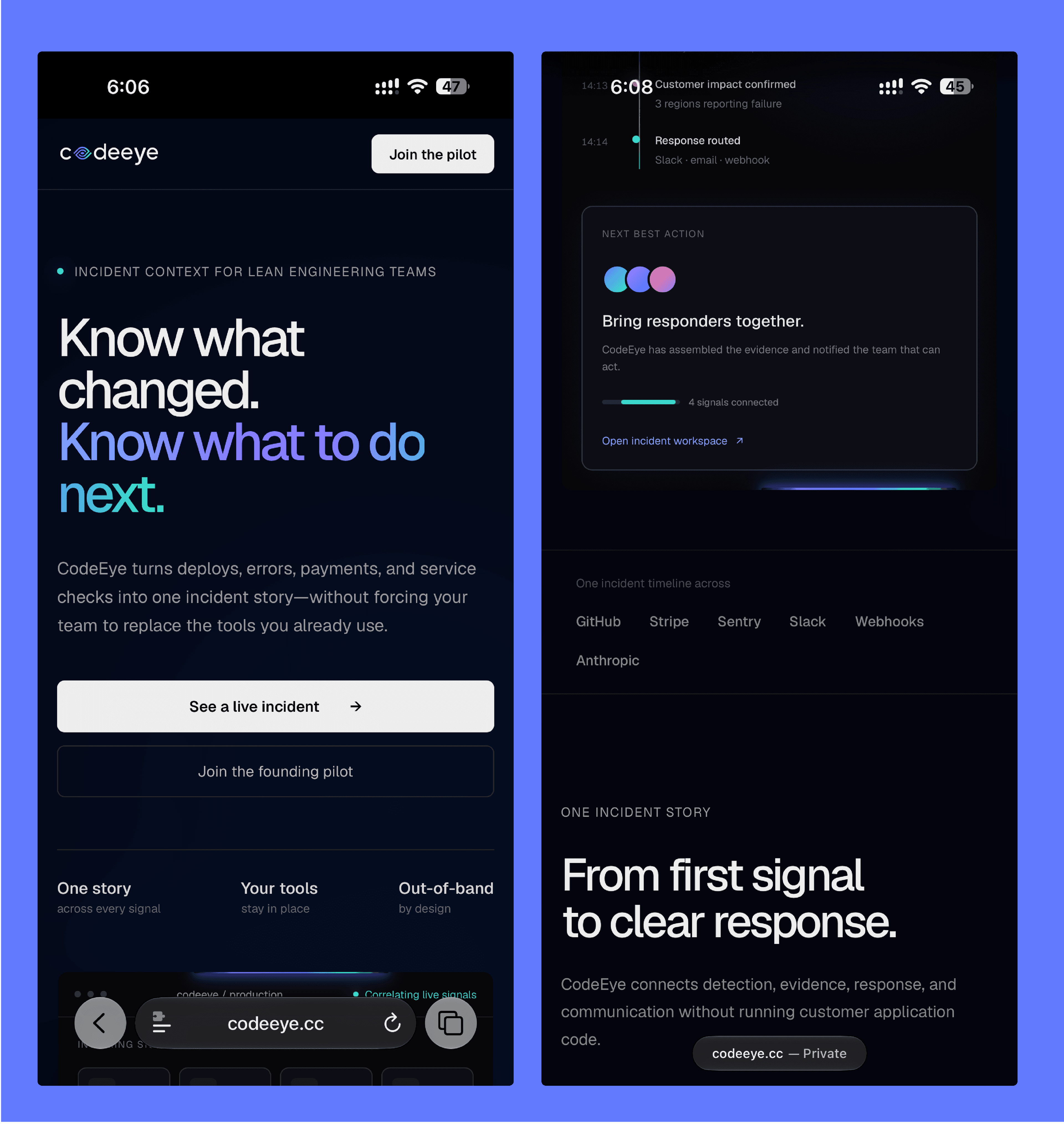
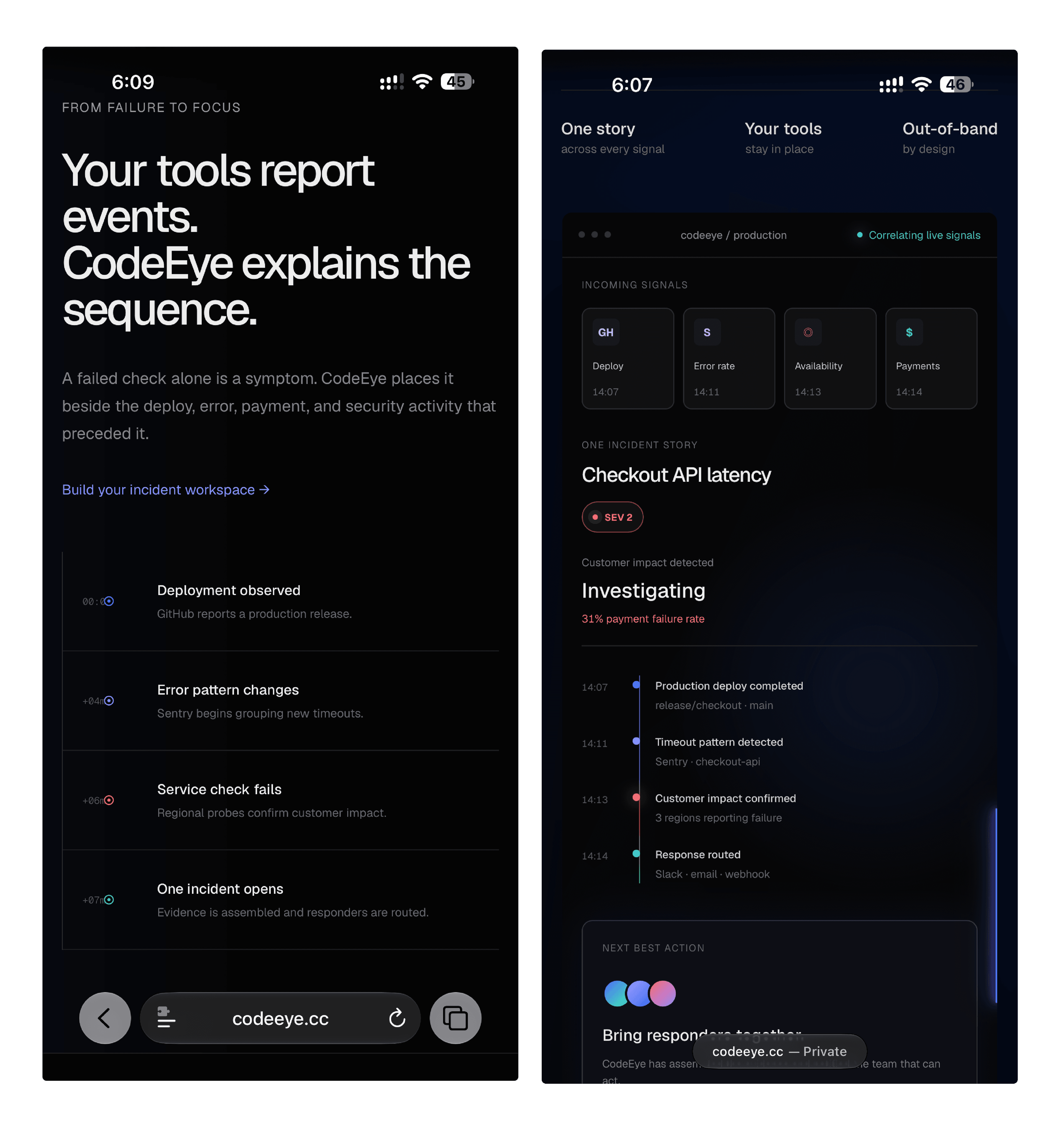
The images in this section are real screenshots captured from the live codeeye.cc marketing website: its homepage hero and its three-step incident-process explainer. The incident-timeline panel shown in these screens is an illustrative interface mockup built for the marketing site, not a live monitoring dashboard or real operational data, consistent with where the product actually stands today. CodeEye does not yet have a backend, and no screens from a connected, data-driven product exist to show here.
Technology Stack
The verified frontend stack, and what has not been built yet.
CodeEye's frontend is built with Next.js and React, written in TypeScript, and styled with Tailwind CSS using a shadcn and Radix UI component system. Charting support comes from Recharts, icons from Lucide, and interface notifications from Sonner. Typography runs on Google's Sora, Inter, and JetBrains Mono fonts.
CodeEye does not yet have a backend service, a database or persistence layer, authentication, real monitoring or alerting integrations, real-time data collection, any implemented AI functionality, or deployment and hosting infrastructure. These remain future work, not implemented capabilities.